Late Sets and Long Roads: The Jazz Life Mitch Winehouse Never Left Behind
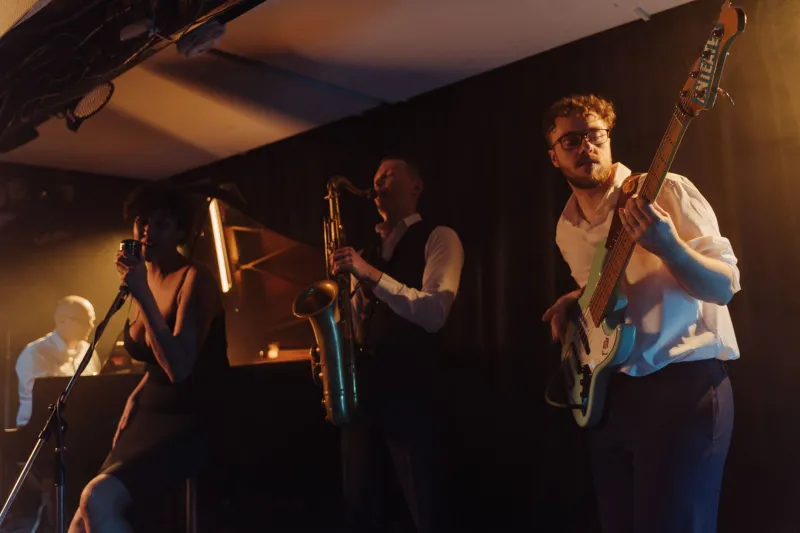
The fare who kept a songbook in the cab
For years, Mitch Winehouse's working life was measured in fares. He drove a taxi, criss-crossed London, and listened to the city change around him. But there was always another soundtrack running underneath: the Great American Songbook, the jazz standards he had loved since he was a boy, and the kind of pub gigs where the piano is slightly out of tune and nobody minds very much.
That is the part of the story people sometimes skip. Before the foundation, before the public appearances, before the tributes to Amy, there was a man who simply loved to sing. In 2026, that man is still performing for charity audiences, still choosing songs from the same well, and still getting a kick out of a room that leans in to listen.
Mitch has never presented himself as a careerist. The music was not a ladder to climb. It was a place to be. He sang in pubs and clubs around London when he could, working the kind of sets that teach you how to hold a room without a light show or a click track. A taxi driver's ear is a useful thing for a singer: you learn to read people quickly, to judge when to push and when to leave a little space.
A record built on affection, not artifice
The album Rush of Love arrived in 2011, and it remains the clearest document of Mitch's relationship with these songs. It is not a celebrity vanity project. It is a love letter to standards, sung by a man who has spent decades listening to them properly.
You can hear that in the choices. Mitch is drawn to songs with a story and a bit of wit, the kind of material that rewards a singer who does not over-explain. They Can't Take That Away from Me, I Get a Kick Out of You, Someone to Watch Over Me: these are not obscure selections, but they are not just crowd-pleasers either. They require a certain ease, a willingness to let the melody do its work.
His phrasing has the quality of someone who has spent a lot of time in cars, thinking. He does not rush the punchline. He does not decorate every line. He sings as a fan, which is one of the most appealing things a jazz singer can do. The best pub jazz is rarely about showing off. It is about sharing something you love and hoping the room loves it too.
The family inheritance
Of course, the Winehouse name carries its own weight. Amy grew up in a house where jazz was not a museum piece but a living presence. Mitch's records, his gigs, his enthusiasm: these were part of the air she breathed. The connection between his love of Dinah Washington and Sarah Vaughan and Ella Fitzgerald and the sound Amy later made is well documented, but it is worth remembering that it began at home, in ordinary ways.
The family legacy is not only about tragedy or tribute. It is also about curiosity. Mitch has always been a listener first. That is what he passed on: the idea that a song can be a companion, a conversation, a way of making sense of the day. The Amy Winehouse Foundation carries that spirit into music education and support for young people, and Mitch's own performances often sit alongside that work rather than apart from it.
Charity nights and the second act
In 2026, Mitch's appearances tend to be for causes rather than chart positions. He turns up, sings a set of standards, tells a few stories, and helps put a few more pounds in the bucket. The rooms vary: charity dinners, community halls, jazz nights with a raffle and a slightly wonky PA. The scale is not the point. The point is the gathering.
A musical second act is often framed as a comeback, but this is not that. Mitch never really left. He just kept singing, and the world eventually caught up with the idea that a good song well sung is worth making time for. He still loves performing for a cause because it combines the two things that have shaped his life: jazz and community.
When he sings, you can hear the long road behind him. The taxi years, the family years, the foundation years. The songs have not changed much. Neither has the reason for singing them. As he has shown in 2026, a great standard does not need a reinvention. It needs a singer who means it.
For us at Mitch Winehouse & Friends, that is the story worth telling: not a man chasing the spotlight, but a man who found his spotlight in the corner of a room, with a band behind him and a good cause in front.