The Unseen Engine: How Jazz Conservatoire Graduates Keep Amy Winehouse Tribute Nights Honest
Photo: Murphy for Florida Department of Commerce, Public domain, via Wikimedia Commons
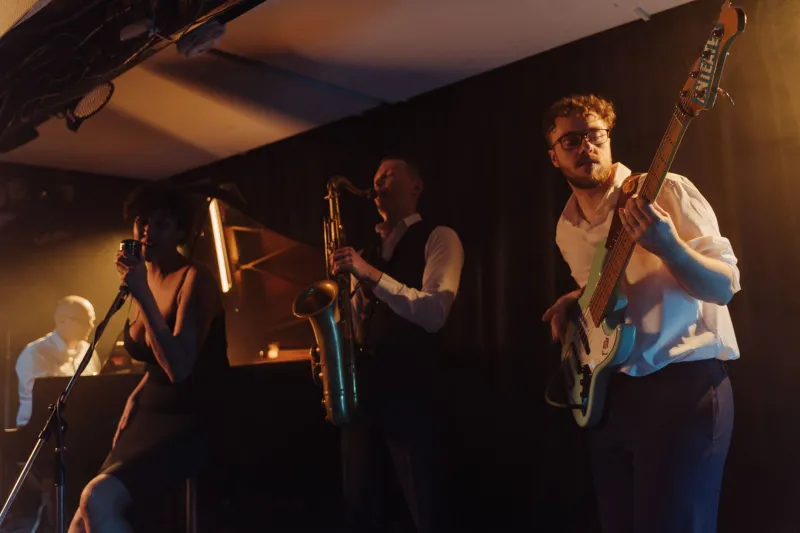
There is a moment, about three songs into any decent Amy Winehouse tribute night, when the room stops watching the singer and starts listening to the band. It is rarely a conscious decision. The drummer drops into a half-time shuffle, the bassist walks a line that owes as much to Motown as to Mingus, and the horn section leans into a phrase that sounds suspiciously like a jazz club at closing time. Suddenly the night has a pulse. And the people providing that pulse are, more often than not, recent graduates of a British conservatoire.
The Chart Is the Teacher
Walk into a rehearsal for one of the better tribute shows and you will not find a stack of lyric sheets. You will find chord charts, horn arrangements and a rhythm section arguing about whether the second chorus should push or lay back. The musicians behind the singer are typically products of places like Leeds Conservatoire, Royal Birmingham Conservatoire, Trinity Laban or the Royal Academy of Music. They can read, they can transpose, and they can hear a modulation coming before the singer does.
That matters because Amy's catalogue is not as simple as it sounds. Songs like I Heard Love Is Blind or Moody's Mood for Love sit on jazz harmony that rewards close attention. The vamps need space. The horn lines need precision without stiffness. A conservatoire graduate arrives with the technical toolkit, but the real education begins when they have to make those arrangements breathe in a pub back room with a slightly out-of-tune piano.
Chemistry Beats Copying
The best tribute bands are not copyists. They understand that the original recordings were made by a particular group of musicians on a particular day, and that trying to replicate every ghost note is a fool's errand. What they replicate instead is the conversation. The drummer and bassist lock in. The guitarist comps like someone who has listened to a lot of Freddie Green. The pianist knows when to fill and when to get out of the way.
This is where jazz training earns its keep. Conservatoire courses are built around small-group playing, and that means learning to listen while you play. A horn player who has spent three years in a quintet knows how to tune a chord by ear. A bassist who has played in a Monday-night big band knows how to set up a tempo without dragging. These are not skills you can fake with a backing track.
The Charity Circuit as a Woodshop
Many of these young musicians cut their teeth on the charity circuit. Church halls, pub function rooms, community centres, the kind of gigs where the fee is modest and the expectations are high. You learn quickly when there is no lighting rig and no monitor engineer. You learn how to balance a horn section in a room with a low ceiling. You learn how to play quietly enough for a speech, and how to bring the energy back up when the raffle is over.
It is also where the community spirit of the tribute scene really lives. The Amy Winehouse Foundation has long supported music education, and the musicians who play these fundraisers often find themselves donating their time or mentoring younger players. It is a circuit that runs on goodwill and good timekeeping, and it produces bands that can handle anything.
What the Audience Misses
When the lights go down, most eyes stay on the singer. That is natural. But the next time you are at a tribute night, try a small experiment: close your eyes for one chorus. Listen to the bassist's note choices. Listen to how the drummer uses the hi-hat. Listen to the way the horns answer the vocal line. You will hear a different gig, one that is happening just behind the spotlight.
It is the kind of detail Mitch Winehouse tends to notice. A lifelong jazz fan, he has often spoken about the importance of the band in any performance, and it is not hard to see why. The singer may be the story, but the band is the engine. Without it, the songs are just words and melody. With it, they become a night out.
A Word From the Front Row
The next time you see a tribute night advertised in a small town or a city basement, look at the small print. Those names at the bottom of the poster are not filler. They are the reason the night will swing, shuffle and soar. They are the unseen engine, and in 2026 they are keeping Amy's music honest, one charity gig at a time.