The Register and the Repertoire: Britain's Weekend Amys on Why Charity Jazz Deserves Their Best
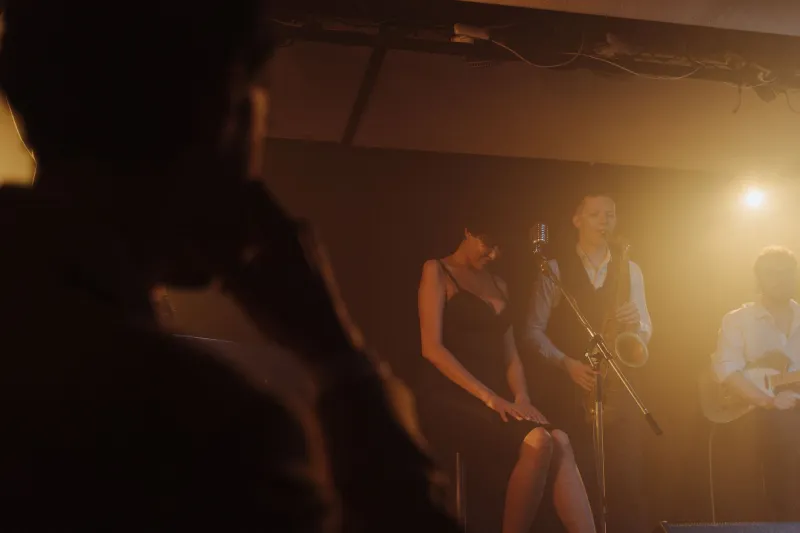
On a wet Tuesday morning in Leeds, Nadia is checking a toddler's observations and reassuring a mother who has barely slept. By Saturday evening she will be six feet from an upright bass, singing "Back to Black" to two hundred people who have each put a tenner in a bucket for music lessons. She calls it, with a grin, "the best second job in Britain — it just happens to pay in applause and raffle tickets."
Nadia is 34, a paediatric nurse, and one of a quiet army of part-time Amy tribute singers who keep charity jazz nights alive from Rotherham to Reading. They are teachers, nurses, bookkeepers, teaching assistants and receptionists. They rehearse on Wednesdays, drive home at midnight on Saturdays, and are back at the desk by Monday. And in a circuit where the Amy Winehouse Foundation's name sits on the poster and every ticket is doing double duty, they have become something close to indispensable.
The Tuesday-to-Saturday handover
Colin, 51, balances other people's books in Swansea. He started singing Amy's material after a charity night at his local rugby club needed a last-minute stand-in and he happened to know every word of "Love Is a Losing Game". Seven years later he has a fortnightly rehearsal with a four-piece band, a rail of second-hand dresses he is oddly proud of, and a firm rule that he will not take a booking that clashes with month-end.
"Month-end is non-negotiable," he says. "Clients get twitchy. But Saturday is mine. My wife calls it my church."
Priya teaches music at a secondary school in Leicester, which means she spends her week telling teenagers to support their breath and her weekend doing exactly that in front of a paying crowd. "The irony isn't lost on me," she says. "But the kids love it. Some of them come to the gigs with their parents. One of them asked me if Amy Winehouse was jazz. That turned into a whole term's worth of lessons."
What a ward teaches you about a room
Ask these performers what their day jobs bring to the stage and the answers get interesting fast. Nadia reckons a shift on a children's ward is the best training in reading a room that anyone could ask for. "You walk in and within ten seconds you know whether to be loud, quiet, funny or just present. You can't fake it. A gig is the same. You can tell in the first eight bars whether the audience wants the big numbers or whether they want to be let in gently."
Priya talks about pacing — the discipline of a forty-minute lesson plan translated into a fifty-minute set. Colin talks about calming a nervous client, which is not a million miles from settling a nervous audience before a difficult song.
None of them describe themselves as hobbyists. That word comes up only when they are complaining about other people using it.
The corporate offer and the charity bucket
Here is the part that surprises people who only see the stage. Most of these singers could earn considerably more doing corporate functions and weddings. Some do. But a striking number deliberately tilt their diaries towards charity work — school fundraisers, hospice nights, community jazz afternoons, tribute evenings in aid of the Amy Winehouse Foundation's music education programmes.
"I did a corporate do once," Colin says. "Lovely people, good money, and absolutely nobody watching. I came home and told my wife I'd rather do a church hall where the raffle takes twenty minutes and the vicar cries at 'Valerie'."
The trade-off is real, though. Part-time performers absorb the costs that full-time acts can build into a fee: petrol, rehearsal room hire, backing tracks, a decent microphone, the occasional replacement dress because a strap gave up mid-set. On a charity bill, those costs come out of the singer's own pocket far more often than anyone in the audience realises.
Please stop calling them amateurs
This is where promoters can make a genuine difference, and it costs very little. The first thing is language. "Amateur" in a press release reads as a warning; "part-time professional" reads as a choice. The second is the running order — do not park a weekend singer at 7.15pm before the room has filled and then wonder why the night never quite lifts.
The third is the small, unglamorous stuff. A soundcheck that actually happens. Somewhere private to change. A parking space that isn't three streets away. A line in the programme saying who they are and what they do for a living, because audiences love that detail and it makes the charity connection legible.
The fourth is money. Even a modest fee — or a clear, upfront arrangement about expenses — signals that the performance is valued. Most weekend singers will happily donate their fee back on the night; being asked is the point.
The ethos behind the bucket
The charity jazz circuit that Mitch Winehouse has championed for years has always rested on the idea that tribute is not imitation for its own sake. It is a way of keeping songs in the room, and using the room to fund the next generation of musicians. The teachers, nurses and bookkeepers who give up their Saturdays are the practical expression of that idea: people with proper jobs choosing to spend their free time making sure a hall in Rotherham raises enough for a dozen instruments.
They are not filling in. They are the bill.
The school run encore
By half eleven on Saturday, Nadia is usually packed down and heading for the car, because Sunday is a long shift and Monday is a school morning. She has a flask, a change of shoes and a running joke about the glamour of it all.
"People think it's a hobby," she says. "It's not. It's the thing I do so that a kid somewhere gets a trumpet. And honestly? I'd rather be tired on a Sunday than not do it."
If you run a charity night, book one of them. Pay them properly, or at least offer to. Put their name on the poster. And when the bucket goes round, remember that the woman singing probably drove ninety minutes to be there — and has a shift in the morning.